

Reviewed By: Personal Injury Team Last Updated: June 29, 2026
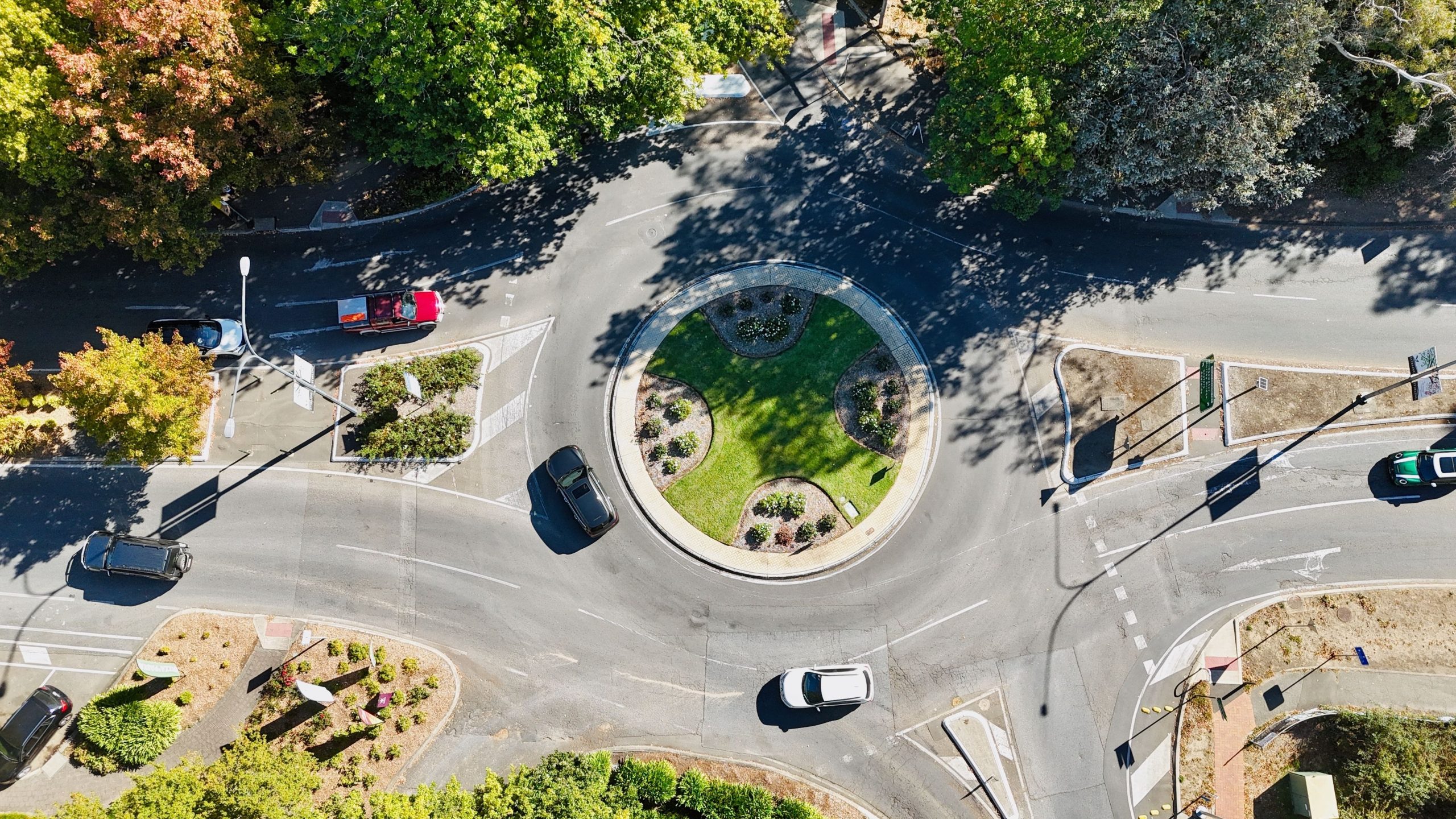
If you’ve been behind the wheel for any number of years, you’ve likely come across all types of four-way intersections including the dreaded roundabout.
Roundabouts, or traffic circles, were first designed and installed in 1905 as a way to improve the flow of traffic and reduce accidents that had already become too familiar at signaled and unsignaled intersections.
While designed to keep vehicles moving seamlessly, entering one can feel like an anxiety-inducing, free-for-all game of bumper cars. So, what do you do when your entrance into the circle results in an accident?
Who Has the Right-of-Way in a Roundabout?
While roundabouts are designed to make intersections safer to navigate, they are not always foolproof, particularly when you don’t understand the right-of-way basics.
Yield to Traffic Already in the Roundabout
This may go without saying, but cars already circling the roundabout have the right of way. To drivers entering, this means to come up slowly and wait for an opening to make your entrance.
Yield to Pedestrians and Cyclists
Just as pedestrians and cyclists have priority at intersections controlled by stop signs or traffic lights, they have the right-of-way at crosswalks around a roundabout. Depending on the traffic circle, crosswalks may not always be present, so remain alert to your surroundings of those who prefer two feet or two wheels compared to four.
Stay in Your Lane While in the Roundabout
Roundabouts can come in many configurations, from one-lane circles to two-lane circles. It’s critical to your safety and the safety of those around you to stay in your lane while in the roundabout, or else you could increase the risk of an accident.
Signal Before Exiting
Signaling before exiting allows other drivers to anticipate your actions before you make them. While it may seem like a simple gratuity, it can give other drivers a heads-up before they make a hasty decision, saving everyone from a potential collision.
Do Roundabouts Cause More Accidents… or Limit Them?
While roundabouts are not a foolproof means of avoiding the unexpected, they do provide a safer alternative than intersection signals and stop signs.
According to the Insurance Institute for Highway Safety (IIHS), intersections in the United States that converted to roundabouts found a reduction in injury crashes of between 72 to 80% and reductions in all crashes of between 35 to 47%.
Based on results from a 2004 study, the IIHS estimated that roughly 50,000 crashes had been prevented in 2023 including 290 fatal crashes and more than 32,000 crashes involving injuries. That’s all thanks to the conversion from signalized intersections to roundabouts.
Despite roundabouts providing a safer means of travel for many commuters, misunderstandings and misjudgments can still result in an unexpected accident.
Common types of crashes seen in a roundabout include:
- Failure to yield to traffic already inside
- Changing lanes within the roundabout, leading to sideswiping or rear-end collisions
- Sudden stops
- Speeding
Determining Fault in Roundabout Accidents
Roundabout accidents are not always clear as to where the fault lies. When an accident occurs, police, insurance companies, and the court system will start with one basic principle: right of way.
For example, if you are inside the roundabout and someone merging in collides with you, they will most likely be found at fault for failing to yield.
Traffic circles are not always clear as to fault, so the help of a car accident lawyer near you becomes a critical component to helping build your case and receive compensation.
Our attorneys will analyze various forms of evidence that can help determine fault, including:
- Dashcam or traffic footage
- Witness statements
- Police reports
- Photo evidence of the damage and vehicle positions
Don’t Go Around in Circles When it Comes to an Accident – Contact Hoffman Law Firm Today
When it comes to recovery after a roundabout accident, you shouldn’t have to go in circles with fault or compensation.
Just leave it to Hoffman.
Our personal injury law firm proudly advocates for accident victims throughout the Palmetto State. As the locals’ trusted personal injury law firm, we have extensive experience handling a wide range of cases.
We have established a reputation for success and excellent service! To meet with a member of our team, schedule your free consultation today. We are here to help!
Explore more on auto accident claims here:
- Who is At Fault in a Left Turn Accident in South Carolina?
- Who’s At Fault In an Accident Caused By Weather?
- Who’s At Fault in a Roundabout Accident?
- Hydroplaning Car Accident: Who Is at Fault?
- Accidents Involving An Uninsured Driver, Who Pays?
- What Should I Do in a Car Accident with an Uninsured Driver?
- How Many Points Do I Lose When I Get Caught Using My Phone While Driving in South Carolina?
- Can I Get a Ticket for Looking at My Phone at a Red Light in South Carolina?
- After A Car Accident, How Many Points Do I Lose On My SC Driver License?
- View All Blogs
Sources
- SCDOT Roundabout Navigation and Safety Guidelines: The South Carolina Department of Transportation (SCDOT) explicitly defines the state’s rules of the road for navigating modern traffic circles, including mandatory yielding protocols, proper lane selection, and turning signal requirements.
- S.C. Code § 56-5-1900 – Driving on Roadways Laned for Traffic: The formal state statute establishing that drivers must maintain a single lane and cannot change lanes or straddle markers until it is certified safe to do so—a law central to proving fault in multi-lane roundabout sideswipe accidents.
- S.C. Code § 56-5-2150 – Turning Movements and Required Signals: The legal mandate governing appropriate indicator usage and signaling intent when moving right or left upon a roadway, which directly covers the requirement to signal when exiting a circular intersection.
- Insurance Institute for Highway Safety (IIHS) Intersection Data: Ongoing traffic safety research tracking the reduction of injury and fatal motor vehicle collisions following the structural conversion of traditional signaled intersections into modern roundabouts.
Learn More About Car Accident Claims in Charleston
-
Ready to protect your rights after a traffic circle collision? Learn how our legal team builds bulletproof evidence files and secure a free case review. Hoffman Law Firm team offers a client-first approach, so learn how our Contingency Fee Structure ($0 Upfront Fee) works—meaning you pay absolutely nothing unless we successfully win your case. Free consultation available.
Disclosure & Legal Disclaimer: This blog is for informational and educational purposes only and does not constitute legal advice. Information regarding roundabout rules, right-of-way, crash statistics, and accident liability is provided for general awareness and may not reflect the most current traffic laws or apply to every situation.
Liability determinations in motor vehicle accidents depend on the specific facts of each case, available evidence, and applicable South Carolina law. References to studies, safety statistics, and general crash trends are provided for context only and do not guarantee outcomes in any legal matter.
Reading this content does not create an attorney–client relationship. For advice specific to your situation, consult a qualified South Carolina personal injury attorney.

